
Contact

Collaboration that creates international competitive advantage
It's about the magic of collaboration and the role of the metal research institute Swerim in the time of transition. Swerim's CEO and chairman of the board meet in a conversation where we start with a time journey.
It’s all about the magic of collaboration and Swerim’s role in times of transition. Swerim’s CEO and chairman meet in a dialogue that starts with a look in the rear-view mirror.
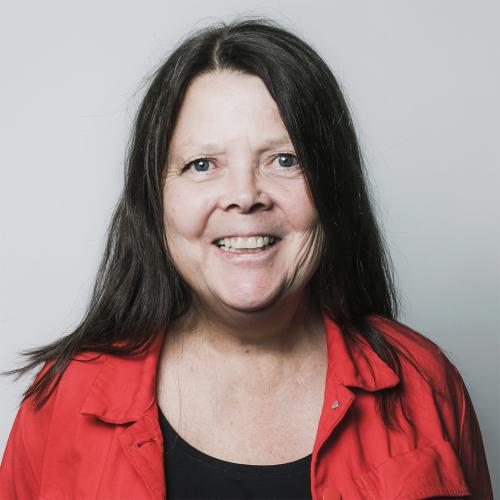
Photo: Left Martin Pei, Executive Vice President & CTO SSAB; Chairman of Swerim and co-founder of the Hybrit initiative. Righ: Pontus Sjöberg, CEO Swerim.
Looking back ten years, could you have foreseen where we would be now in the transition away from fossil-fuel dependency?
Martin: The short answer is no. Ten years ago I focused on developing SSAB's business in Asia. There was a lot of optimism and a great ambition to find new markets. Climate change was not at the top of the agenda. I first became really aware of the implications of global climate change in the summer of 2015. With the Paris Agreement it became evident that the time was right to invest time, energy and research towards the quest for fossil-free steel.
Pontus: In 2013 I worked for a Russian company in the Czech Republic. There was an open trade climate, but climate change wasn't an issue. Three years later, when I was home in Sweden, I was invited to a dinner and I heard Martin discussing the coming Hybrit venture. I thought, "Well, we'll see where this goes". To me, it sounded like a rather daring project. Today, I would say that Hybrit is the basis for the entire green transition in Sweden, as well as a driving force in Europe.
Just ten years ago no one had any idea that industry would face a green transition, which attests to the fact that the process is moving at a rapid pace. Why are things progressing so quickly?
Martin: Of course, it has to do with the fact that there has been an awakening across the entire value chain. And the fact that the transition to fossil-free production creates incredible business opportunities. Actually, the great challenge is that we want to run faster than we can.
Pontus: The industrial transformation and business opportunities are spilling over on us, as a research institute. Swerim was formed in 2018, when Swerea MEFOS and parts of Swerea KIMAB merged. This merger was initiated by the industry. With the start of Hybrit, the metals industry foresaw the need for a broader research institute with knowledge of the whole value chain. But even as recently as 2018, no one realized how quickly that need would arise.
What role is Swerim playing in the race towards the goal of a fossil-free industry?
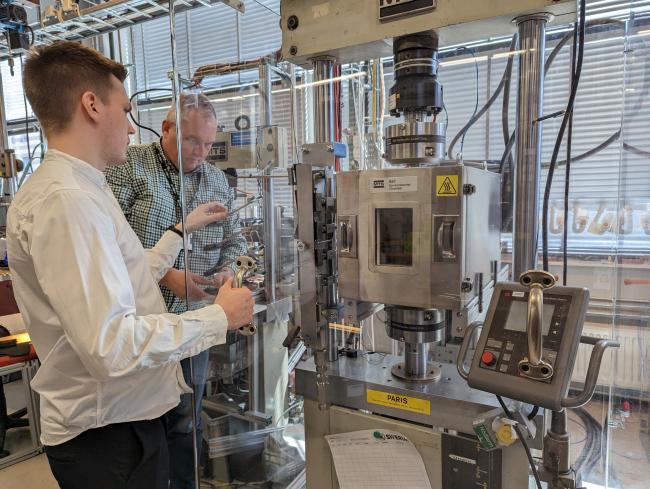
Pontus: The transition requires innovation. Often, there is not simply one answer to the problem. It depends on local conditions. As a research institute, we are able to customise solutions based on specific needs in industry. Our pilot-plant facilities create unique possibilities for research involving industrial-scale trials.
Martin: Sweden is driving development in the green transition, but we are a small country. We don't have the same muscles as our multinational competitors, who have their own, in-house research departments. Instead, we have a joint research institute that covers the entire value chain from mine to finished product. Swerim is a puzzle piece that enables our competitiveness.
Pontus: Exactly! Actually, we in Sweden should be too small when it comes to R&D resources, but we are good at optimising our resources within academia, institutes and industry.
Hydrogen is a key to the transition. Swerim is now introducing a hydrogen initiative – National Hydrogen Research Centre for Metallic Materials – what does that entail?
Collaboration that creates international competitive advantage.
Pontus: We offer companies the chance to set up their processes in our pilot plants in Luleå and Kista. On the process side we have a hydrogen electrolyser and on the process side we provide testing of materials in a hydrogen environment. And we have a third offering; research concerning the capture, storage and reuse of carbon dioxide, which will continue to be a by-product of industrial processes, even in the future.
Martin: The hydrogen initiative is a good example of how Swerim will be an enabler for industry, in a small country like Sweden. We simply cannot afford to run parallel processes, we have to collaborate. We have neither the financial strength nor sufficient engineers to be able to pursue our own, in-house research of this type.
Swerim engages in a lot of joint initiatives with industry. For example, we have an atomizer plant in Kista, for manufacturing and development of metal powders. Has it attracted much interest?
Pontus: A lot of interest; in fact, from all over the world. But as long as there is a queue, we have to prioritise Swedish companies, since we are an institute in which Swedish industry has an 80-percent ownership interest. This facility is an excellent example of our collaboration with industry, which Martin has also described. The plant is a joint investment that has been made by Swerim and several companies. Participating investors can do their own, confidential research while we, as a research institute, can conduct relevant, publicly funded research with expensive technical equipment. We optimise the utilisation of resources for the benefit of industry and society.
Sweden's biggest research collaboration for advanced, fossil-free steelmaking and production was presented this spring. It is a collaborative venture, with funding amounting to 46 million kronor, between LTU, SSAB and Swerim. What is the aim of this project?
Pontus: We seek to determine how fossil-free steelmaking influences the finished product. With this transition we are taking a giant leap into the hydrogen society. Hydrogen and metals are not a good combination if they are not handled correctly, since hydrogen can make the material brittle. We are going to verify how to produce the right types of steels for different types of applications. This research package gives us a fantastic opportunity.
Martin: Indirectly, we will also secure the competencies we need, since several doctoral positions will be funded. But, above all, this will be just one more example of how good we are at collaborating in Sweden. We really should be very proud of that. It is largely thanks to our ability to collaborate that we can be so far ahead at the forefront of research, even though we are a small country.