
Contact


Swedish Foundries Lead the Way – Fossil Carbon Replaced by Biochar from Swedish Forests
Could Swedish forests become a key source of raw materials for the metals industry while reducing dependence on imported fossil-based materials? Successful industrial trials in Västerbotten now demonstrate that fossil carbon and graphite can be replaced by metallurgical biochar produced from Swedish forest biomass.
For the first time, the two specialist foundries Norrlandsgjuteriet and Kåge Gjutmek have successfully conducted production trials demonstrating that fossil carbon and graphite—raw materials currently largely imported from other parts of the world—could in the future be replaced by a Swedish alternative while also reducing the climate footprint.
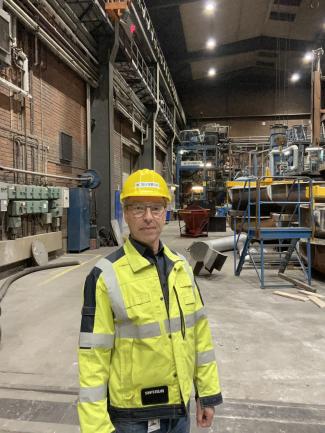
“Sweden’s steel and metals industry faces a green transition that is about more than simply reducing emissions. It is also about securing access to critical raw materials and building competitive value chains for the future. The project results show that Swedish biomass can help replace imported fossil-based carbon materials in metallurgical processes. This is an important step towards a more sustainable, resilient and competitive industry,” says Lars Sandberg, Project Manager at Swerim. As the industry’s research partner, Swerim works closely with companies to translate research into industrial solutions that can be implemented in practice.
Carbon and graphite are essential inputs across large parts of the metallurgical industry. Today, many European industries depend on imports from a limited number of countries and regions. Recent geopolitical developments—from the war in Ukraine to growing tensions in several parts of the world—have highlighted the vulnerability of global supply chains.
For Swedish industry, this is a strategic issue. If access to fossil carbon becomes restricted, the consequences could be significant for both civilian and defence industries.
“This is about much more than replacing fossil carbon with biochar. We are demonstrating that industrial competitiveness, security of supply and the green transition can all be combined in a single solution,” says Peter Göttfert, CEO of Norrlandsgjuteriet.
The trials demonstrate that Swedish forest biomass could provide the basis for a domestic alternative.
“We often talk about the green transition as a climate issue. But it is also about resilience, self-sufficiency and security of supply. Solutions that both reduce emissions and strengthen Sweden’s industrial preparedness will become increasingly important,” says Martin Gemvik, Business Developer at Envigas.
The successful results from the trials in Västerbotten demonstrate that the transition towards fossil-free or substantially fossil-reduced metallurgical processes is no longer merely a vision for the future—it is already being tested and verified on an industrial scale.
“In the longer term, the technology could become significant for a wide range of industries where carbon-based materials are used in production processes, from foundries and steelworks to defence-related manufacturing and other industries critical to society,” says Karin Ågren, Project Manager at IVL Swedish Environmental Research Institute.
The trials were conducted in collaboration between IVL Swedish Environmental Research Institute, Swerim, Envigas, Norrlandsgjuteriet and Kåge Gjutmek as part of the HOME project. The project is co-funded by the European Union through the Just Transition Fund.
Background to the HOME Project
The work has been carried out within the HOME project, a collaboration between IVL Swedish Environmental Research Institute, Swerim, Envigas, Norrlandsgjuteriet and Kåge Gjutmek. The project was initiated to investigate whether renewable biocarbon can replace fossil graphite and other fossil carbon materials in metallurgical processes without compromising product quality or process reliability. By taking the material from laboratory evaluation and pellet development through scale-up and industrial foundry trials, the project aims to establish a practical pathway for introducing Swedish forest-based carbon into metallurgical production.
The HOME project is co-funded by the European Union through the Just Transition Fund.